
Grass-Fed Beef Liver: Food or Supplement—Amazing Benefits!
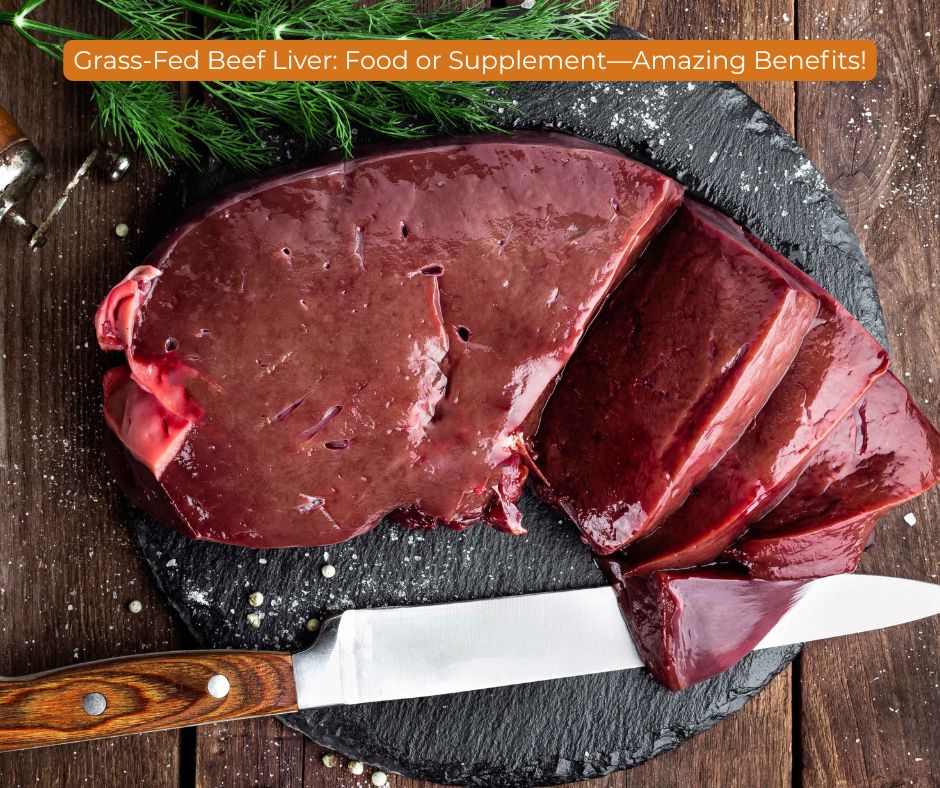
Grass-Fed Beef Liver: Food or Supplement—Amazing Benefits!
Grass-Fed Beef liver is one of the most nutrient-dense foods on the planet—especially for vitamin A, B12, copper, iron, riboflavin, and choline. A small serving can cover key micronutrients that support energy, red-blood-cell production, thyroid and skin health, and methylation. Because vitamin A and copper are very high, portion size and frequency matter. Desiccated (“freeze-dried”) liver capsules are a convenient alternative—but choose third-party–tested brands and watch the vitamin A content.
Why Beef Liver Stands Out
Micronutrient powerhouse. A typical cooked serving (~3 oz / ~85 g) of beef liver delivers enormous amounts of:
Vitamin B12: ~70.7 mcg (far above the daily need) → supports energy metabolism and nerve health.
Office of Dietary Supplements
Vitamin A (preformed retinol): ~6,273 mcg RAE per ~81 g slice → crucial for skin, vision, and immune function (but easy to overdo; see safety).
Copper: ~11.8 mg per ~81 g slice → essential for antioxidant enzymes and iron transport (again, very high).
Heme iron: ~5 mg per 3 oz, in a form your body absorbs better than plant iron.
Riboflavin (B2) & folate: ~2.8 mg B2 and ~210 mcg folate per ~81 g slice—key for energy and methylation.
My Food Data
Choline: ~340–420 mg per 80–100 g—supports liver function, bile flow, and brain health.
Bonus: About 22 g protein in a 3 oz (85 g) cooked serving of beef liver. Beef liver contains small amounts of coenzyme Q10 (CoQ10), which participates in cellular energy production.
What benefits can people actually expect from beef liver?
More “get-up-and-go” if you’re low on B12 or iron. The B12 and heme iron combo in liver supports red-blood-cell production, oxygen transport, and energy. (Heme iron from meat is more bioavailable than non-heme iron from plants.)
Skin, vision & immune support—thanks to retinol. Preformed vitamin A (retinol) in liver is the bioactive form your body uses directly. It’s powerful so see the safety notes below about dose and pregnancy.
Methylation & liver health helpers. Riboflavin, folate, and choline (abundant in liver) support methylation, bile flow, and healthy liver function.
Grass-fed vs. conventional: does it matter nutritionally?
Most research comparing grass-fed and grain-fed beef focuses on muscle meat, where grass-fed tends to have a more favorable fat profile (more omega-3s/CLA). Organ meats like liver are very lean (low total fat), so fatty-acid differences are likely less impactful and direct data on liver are limited. Many people still prefer grass-fed for husbandry/traceability reasons.
Food vs. supplements (desiccated liver)
What the capsules are: Freeze-dried, powdered liver in gelatin capsules basically liver with the water removed. Nutrient levels vary by brand and serving size.
Typical serving: Many labels provide ~3,000 mg dried liver per serving (often 6 caps). One example lists ~5,099 IU vitamin A (~1,530 mcg RAE) and ~13.6 mcg B12 per serving—about half a day’s vitamin A UL and >5× the B12 DV. Always check your label.
Quality matters: Supplements aren’t pre-approved by FDA. Look for USP or NSF third-party verification to reduce the risk of mislabeling and contaminants.
How much & how often?
Because liver is so concentrated, small amounts go a long way.
Food: Many clinicians and RDs suggest modest portions (e.g., ~1 oz / 28 g once weekly) to reap benefits while keeping vitamin A and copper in check. A single ~81 g slice already contains ~6,273 mcg RAE vitamin A—more than double the adult UL of 3,000 mcg RAE/day—so frequent large servings aren’t necessary.
Supplements: If you use desiccated liver, add up all your vitamin A sources (multivitamin, cod-liver oil, fortified foods) to avoid exceeding the UL on a consistent basis. (1 IU retinol ≈ 0.3 mcg RAE.)
Important: The vitamin A UL is a daily threshold, but retinol is fat-soluble and accumulates. Think in terms of weekly averages and avoid stacking high-retinol foods/supplements day after day.
Who should be cautious or avoid it?
Pregnant or trying to conceive: High intakes of preformed vitamin A (retinol) are linked to birth-defect risk. Avoid frequent large servings of liver and high-retinol supplements; speak with your clinician.
Gout: Organ meats are high in purines and can trigger flares.
Iron or copper overload: If you have hemochromatosis (iron overload) or issues of copper overload (e.g., Wilson disease), liver isn’t a good fit. Ask your clinician.
Raw/undercooked liver: Skip it—organ meats can harbor pathogens if not cooked through. (Most outbreaks are documented with poultry livers, but the principle holds.) Cook to safe temps.
Buying checklist (for supplements)
Look for third-party seals: USP Verified or NSF on the label.
Check the Supplement Facts panel: Note vitamin A and B12 per serving; avoid proprietary blends that hide amounts.
Mind the dose: If your multivitamin or cod-liver oil already contains retinol, choose a lower-A liver product or use food only.
Coach’s Pick: Heart & Soil — Her Package Supplement

Why I like it
Her Package supplement is packed with vital nutrients and peptides to support hormonal balance.
They do third-party testing by independent labs during and after manufacturing.
100% Additive, hormone, allergen, antibiotic, pesticide & GMO-free.
Who it’s for
Support for women struggling with reproductive health, menopause and perimenopause
How to use
Start low (e.g., 2 capsules with a meal), then work up toward the label serving if desired.
Track how you feel (energy, cravings, skin) for 2–4 weeks.
Important cautions
Avoid or use only under clinician guidance if pregnant/trying to conceive, if you have gout, iron or copper overload, or take medications that interact with vitamin A/iron.
Supplements aren’t a substitute for a varied diet or medical care.
My link (supports this work at no extra cost):
👉 Heart & Soil Her Package Supplements — Use my referral link for 20% Off 👉https://refer.heartandsoil.co/hs5474264
*Affiliate disclosure: If you purchase via my link, I may earn a small commission. I only recommend products I genuinely take myself or find useful.
Practical ways to use it
Food: Pan-sear thinly sliced liver with lots of onions; or blend into meatballs/burgers at 10–20% by weight (“sneaky” liver).
Capsules: Convenient for those who dislike the taste just treat them like a potent multivitamin and track your retinol intake.
Bottom line
Beef liver especially from well-raised animals is a targeted way to cover hard-to-get nutrients like vitamin A (retinol), B12, copper, iron, riboflavin, and choline. Whether you cook a small portion once in a while or use a thoughtfully chosen desiccated supplement, the key is moderation and quality—and paying attention to vitamin A totals.
 Unlock Your Path to Vibrant Health: A Holistic Guide for Health and Longevity