
Your deli meat is classified as a carcinogen. Here’s what a pharmacist wants you to know
“I used to pack turkey and ham sandwiches for my kids every single day. Then I read the actual WHO report. As a pharmacist, I couldn’t unsee it.”

Deli meat, that turkey sandwich you grabbed for lunch today? The ham in your kid’s lunchbox? The salami on your weekend charcuterie board?
The World Health Organization classified every single one of those as a Group 1 carcinogen — the same category as tobacco smoking and asbestos.
Not “possibly causes cancer.” Not “probably.” The WHO’s International Agency for Research on Cancer (IARC) says there is sufficient evidence that processed meat causes colorectal cancer in humans.
I know. I didn’t want to believe it either. So let me walk you through exactly what the science says, what it actually means for your risk, and what I tell my own clients here in Dripping Springs.
Wait, the same category as cigarettes?
This is where most people panic, and it’s where the nuance matters.
Yes, processed meat sits in the same IARC classification as tobacco. But that classification describes the strength of the evidence that something causes cancer, not how dangerous it is. Think of it this way: we’re very confident both cause cancer, but they don’t cause the same amount of cancer.
Smoking causes roughly 1 million cancer deaths per year worldwide. Diets high in processed meat contribute to about 34,000 cancer deaths per year globally. That’s a massive difference in absolute risk.
So no — eating a ham sandwich is not the same as lighting up a cigarette. But the evidence that processed meat causes cancer is just as solid as the evidence for tobacco. That distinction matters.
What counts as “processed meat”?
The WHO defines processed meat as any meat that has been transformed through salting, curing, fermentation, smoking, or other processes to improve flavor or preservation. This includes:
- Deli meats (turkey, ham, roast beef slices)
- Hot dogs and frankfurters
- Bacon and Canadian bacon
- Sausages (breakfast sausage, Italian sausage, bratwurst)
- Salami, pepperoni, prosciutto
- Beef jerky and biltong
- Corned beef
- Canned meat and meat-based sauces
If it’s been processed beyond simple cutting and grinding, it’s on the list. And yes — that includes the “all-natural” and “organic” options at Whole Foods.
The science: what actually happens in your body
My pharmacy brain kicks in here. There are a few mechanisms through which processed meat promotes cancer:
1. N-nitroso compounds (NOCs)
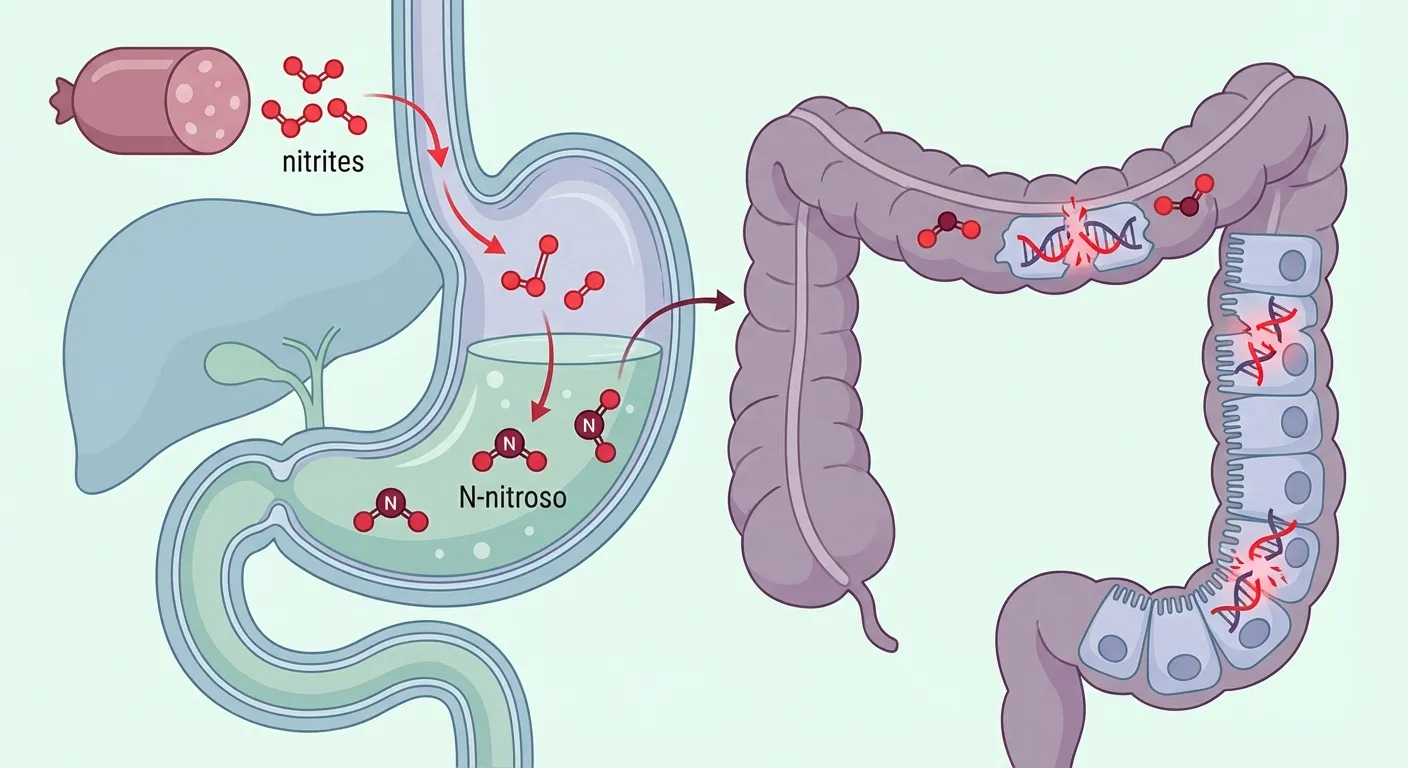
This is the big one. Sodium nitrate and sodium nitrite are added to virtually all cured and processed meats. They prevent bacterial growth (specifically Clostridium botulinum, the bacterium that causes botulism) and give deli meat that pink color.
When you eat these meats, the nitrites react with amino acids in your stomach to form N-nitroso compounds. These are potent carcinogens that damage the DNA in your colon cells, and damaged DNA is step one in the cancer process.
2. Heme iron overload
Processed meats (especially those made from red meat) are high in heme iron. In your gut, heme iron catalyzes the formation of additional NOCs and produces lipid peroxidation byproducts — both of which damage the intestinal lining.
Small amounts of heme iron are fine and necessary. The concentrated doses in daily processed meat consumption overwhelm your body’s ability to neutralize the damage.
3. High-temperature cooking chemicals
When processed meats are cooked at high temperatures (grilled, pan-fried, barbecued), they produce polycyclic aromatic hydrocarbons (PAHs) and heterocyclic aromatic amines (HCAs). Both are established carcinogens. That charred hot dog at the summer cookout is getting hit from every direction.
The numbers: how much risk are we talking about?
The IARC analysis found that each 50-gram daily serving of processed meat increases colorectal cancer risk by about 18%. That’s roughly 2 slices of deli meat or one hot dog per day.
But let’s put that in perspective with absolute numbers:
- Baseline lifetime risk of colorectal cancer: about 4.5% (roughly 1 in 22 people)
- With daily processed meat: risk rises to about 5.3% (roughly 1 in 19)
That’s a real increase — roughly one extra case per 100 people — but it’s not the catastrophic death sentence that headlines suggest. Context matters.
But most Americans aren’t eating just one serving. Bacon at breakfast, deli meat at lunch, sausage at dinner. That compounds quickly. And colorectal cancer isn’t the only concern. The WHO also found associations (though less conclusive) with stomach cancer and pancreatic cancer.
The “nitrate-free” lie
This one genuinely angers me as a pharmacist.
Companies label deli meat as “uncured,” “nitrate-free,” or “no added nitrates” and charge you a premium for it. The label implies it’s safer.
It’s not.

These products use celery powder or celery juice as a curing agent instead of synthetic sodium nitrite. Celery is naturally very high in nitrates. When celery powder is added to meat, bacteria convert the naturally occurring nitrates into nitrites — the exact same chemical that conventional cured meats use.
The result: “nitrate-free” deli meat contains comparable levels of nitrites as conventional deli meat. Your body can’t tell the difference between a nitrite from a chemistry lab and a nitrite from celery. The N-nitroso compounds form either way. The cancer risk is the same.
The USDA requires “uncured” labeling when celery powder is used instead of synthetic nitrites, which creates the misleading impression that these products are fundamentally different. They’re not. It’s a marketing strategy, not a health improvement.
What I tell my clients
I’m not here to tell you to never eat a slice of ham again. That’s not realistic, and the absolute risk from occasional consumption is small. Here’s what I actually recommend:
1. Reduce frequency dramatically
The dose makes the poison. Daily processed meat consumption is where the risk compounds. Aim for once a week or less rather than daily. Your kid’s lunchbox doesn’t need deli meat five days a week.
2. Stop paying extra for “nitrate-free”
Now that you know it’s the same chemistry, save your money. If you’re going to eat deli meat occasionally, the “uncured” version isn’t protecting you. Choose based on taste and quality, not misleading health claims.
3. Replace with real protein
- Rotisserie chicken. Shred it yourself for sandwiches. Takes 30 seconds.
- Hard-boiled eggs. Batch prep on Sunday, grab all week.
- Canned wild salmon or tuna. Mix with avocado instead of mayo.
- Leftover grilled chicken or steak, sliced thin for sandwiches.
- Hummus and vegetables. Surprisingly filling and zero cancer risk.
4. When you do eat processed meat, add protection
Research suggests that vitamin C and polyphenols (found in colorful vegetables and green tea) can inhibit the formation of N-nitroso compounds in the stomach. So if you’re having a hot dog at the ballpark:
- Eat it with a big salad or sauerkraut (vitamin C + probiotics)
- Drink green tea rather than soda
- Add tomatoes, peppers, or other vitamin-C-rich toppings
This doesn’t eliminate the risk, but it may reduce NOC formation.
5. Get screened
If you’ve been eating processed meat regularly for years (most of us have), make sure you’re current on colorectal cancer screening. The American Cancer Society now recommends screening starting at age 45, down from the previous recommendation of 50, partly because colorectal cancer rates are rising in younger adults. Not sure where your numbers stand? A comprehensive lab panel can give you a baseline to work from.
The bigger picture: why I care about this
As a registered pharmacist, I’ve spent 25+ years watching patients deal with the consequences of dietary choices nobody warned them about. Processed meat is everywhere: school cafeterias, hospital food, office lunches, gas stations. It’s cheap, convenient, and deeply embedded in American food culture.
I’m not trying to scare you. I’m trying to give you information your sandwich counter can’t. It’s why I built my health coaching practice around the whole picture, not just one lab result or one headline. The WHO classification happened back in 2015 and most people still don’t know about it.
Small swaps. Less frequency. Real food when possible. That’s the goal. If you’re working on weight loss or managing your diet alongside a GLP-1 medication, these swaps become even more important. The foods you choose matter more when your body is already in a metabolic shift.
Questions about how your diet and medications interact with cancer risk? Schedule a free 30-minute clarity call. I review the whole picture (nutrition, medications, lab results, and lifestyle) because none of it exists in a vacuum.
— Irina Plakas, RPh
Certified Health Coach | Dripping Springs, TX
FAQ
Is deli turkey healthier than deli ham or salami?
From a cancer perspective, not meaningfully. All three are processed using nitrites (or celery-derived nitrites). Turkey deli meat may be lower in saturated fat and calories, which matters for other health goals, but the carcinogenic mechanism applies equally to all processed deli meats regardless of the source animal.
How much processed meat is safe to eat?
The WHO did not establish a “safe” threshold. Risk increases with amount consumed, starting from very low levels. The American Institute for Cancer Research recommends eating little, if any, processed meat. Practically, occasional consumption (once a week or less) keeps the absolute risk increase very small, roughly 1-2% over a lifetime.
Does cooking method matter?
Yes. High-temperature cooking (grilling, pan-frying, barbecuing) adds additional carcinogens (PAHs and HCAs) on top of the nitrite-derived NOCs. Steaming, boiling, or eating processed meat cold (as in sandwiches) produces fewer of these additional compounds, though the nitrite risk remains.
Are organic or pasture-raised processed meats safer?
No. The carcinogenic mechanism is driven by the curing process (nitrites) and heme iron content, not by how the animal was raised. Organic bacon is still bacon. Pasture-raised ham is still processed meat. These may be better choices for other reasons (antibiotic use, animal welfare), but the cancer classification applies regardless.
Should I be worried if I’ve eaten deli meat my whole life?
Don’t panic, but do act. The absolute risk increase is real but modest. The most important step is reducing your current and future consumption, not stressing about the past. Get current on colorectal cancer screening (recommended starting at age 45), increase your vegetable and fiber intake, and gradually replace processed meat with whole-food protein sources.
Sources
- WHO/IARC — Carcinogenicity of Red Meat and Processed Meat Q&A
- IARC Monograph Vol. 114 — Red Meat and Processed Meat (2018)
- The Lancet Oncology — IARC Processed Meat Classification (2015)
- American Institute for Cancer Research — Processed Meat and Cancer
- National Cancer Institute — Chemicals in Meat Cooked at High Temperatures
 Unlock Your Path to Vibrant Health: A Holistic Guide for Health and Longevity